Tuesday, April 5, 2016

Toontastic

In the fall. Ms. Conroy introduced our class to the Toontastic app. The students and I were very excited to learn how to use the app to make movies to tell our own stories. 
(You can learn more about the free Toontastic app HERE.)
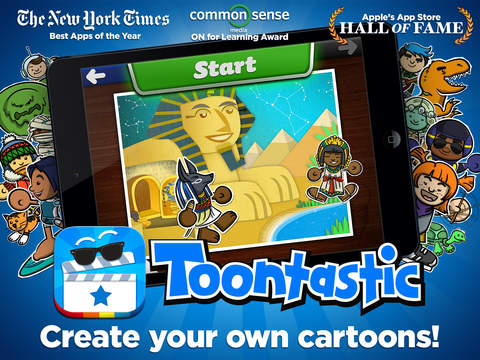
 
 Ms. Conroy created a story with the students to practice. First, they had to select a setting. The app provides many to choose from. Next, they selected characters and decided on a problem one of the characters would have. Finally, they determined the solution to the problem. The students learned that they would create the actions and the voices of the characters. In fact, they would be able to use different voices and accents to speak as the characters. 
Students explored the Toontastic app on classroom ipads during writing time and WIN time. 
They chose characters from those available or created their own using a drawing feature. Students touched the screen to control the movements of the characters and recorded the dialogue of each character using their own voices. This ties in with our second grade reading standards. We practice using different voices when reading dialogue orally.

  One of the benefits of Toontastic is that the story-making process is broken down into five steps, which gives students exposure to the structure of a well-told story.
 
Students also have the option to enhance the mood of each scene by selecting appropriate background music. Once students complete their story, they title their movie and it is saved to the ipad,
where it can be viewed by others.
When we began our genre study of Animal Fantasy, Ms. Conroy showed the students how to create their own Animal Fantasy story, connecting reading and writing. 
Students used a story web graphic organizer to plan their Animal Fantasy story.  Ms. Conroy also created a dialogue graphic organizer that students used to plan out what their characters would say. This allowed students the chance to rehearse the voices of the different characters.
The students enjoyed writing their own stories with dialogue. Below are some of the standards addressed during reading and writing time. 
This app is certainly a fun way to practice these skills!

RL.2.6
Craft and Structure
6. Acknowledge differences in the points of view of characters, including by speaking in a different voice for each character when reading dialogue aloud.

W.2.3
Text Types and Purposes
3. Write narratives in which they recount a well-elaborated event or short sequence of events, include details to describe actions, thoughts, and feelings, use temporal words to signal event order, and provide a sense of closure.

W.2.6
Production and Distribution of Writing
6. With guidance and support from adults, use a variety of digital tools to produce and publish writing, including in collaboration with peers.
                                                                                         Mrs. Begin


Animal Habitats and Adaptations

The Museum of Science in-house field trip was amazing! 
The teacher from the museum brought three live animals for the students to observe. These animals live in different habitats in the wild. Through the use of a slide show and a camera, students were able to examine different features of each animal. One thing we looked at on each animal was its teeth. This helped us determine what type of food the animal eats. The students were made encouraged to use the terms herbivore, carnivore, and omnivore. Students observed other features that could help an animal get food, hide from enemies, and survive in its habitat. As students determined information about the animal, the teacher added it to this large chart. The final task was to determine which habitat the animal lived in. Students began by eliminating the habitats it definitely could NOT live in to narrow the choices.
One of the animals was a hedgehog. She was very shy and spent most of the time hiding in the shavings but the information provided in the slide helped us learn more about her.
       
The other animals were a tiger salamander and a prehensile tailed skink.
Below is a video about a barred tiger salamander.
Here is the chart the students helped to complete.
After the presentation (and a question/answer session) the students got to explore the animal skins and coverings at a touch table.  
   
   
We also got a closer look at the skink!
Later that day, students had the opportunity to draw and write about the field trip. They were able to record what they learned about habitats and the animals we saw.
This is such a great experience. I look forward to this visit every year!
Stay tuned because The Museum of Science will be coming back again
 to teach the second graders about Life Cycles!

Saturday, March 19, 2016

Sequence of Events

During the last 2 weeks, our class has enjoyed several stories from The March Madness Tournament of Books that Mrs. Frey organized for our school. The tournament began with 16 books. The students in our school voted to narrow the 16 to the "Elite Eight" and then the "Final Four". The process continues next week when the Best Book is revealed.

One of the books to be considered was A Bad Case of Stripes by David Shannon. I read the story to the class and it was a big hit! The children enjoyed the humorous plot and were able to identify the author's message. Camilla's problem was solved when she was true to herself!

Students listening to the story at the Listening Center.
You can enjoy the story on Storyline Online by clicking here.

Each pair of students was given a large smile poster and a baggie of 12 lima beans. The students first read the events written on the lima beans to determine which events were from the story and which three were not part of the story. Once students had selected the events, they put them in the correct order by attaching them to the numbered spaces. Through our study of Realistic Fiction and Animal Fantasy, we learned that authors usually introduce the setting and characters at the beginning of the story. The character's problem comes next, followed by a series of events that eventually end in a resolution of the problem, We were able to use this structure to sequence the events in proper order.

Here are some of the partners working to correctly sequence the story events. 
Remember to always be the real you! 
RL.2.5
Craft and Structure
5. Describe the overall structure of a story, including describing how the beginning introduces the story and the ending concludes the action.


free glitter text and family website at FamilyLobby.com

Sunday, March 6, 2016

Force and Motion

During science, we have been learning about forces and how they effect objects. The students have learned about speed and how it is measured. And they have learned about gravity and weight. Finally, we explored friction and how it effects moving objects. 

We concluded our unit by conducting an experiment about friction. 


Our Mission and Essential Questions:
           Determine which material causes the most friction, 
           Determine which material causes the least friction.
This experiment meets the requirements of the 2016 MA Science Standard 2-PS3-1 (MA). Design and conduct an experiment to show the effects of fiction on the relative temperature and speed of objects that rub against each other.

The "Set Up":
I introduced the students to the "set up" of the experiment including several fixed variables. I used 2 dictionaries to prop up a cardboard ramp. I used masking tape to hold the ramp and meter sticks in place. I explained that these items need to stay exactly the same each time we had a trial, which would be letting a car roll down the ramp. The students figured out that the car was also a fixed variable because if we used different cars that might alter our results. 
Then, I introduced the students to the different friction-causing materials, the variable. these materials were to be laid in position at the bottom of the ramp. They included coarse sandpaper, fine sandpaper, terrycloth towel, and non-slip shelf liner. The fifth variable was the rug alone.
                                     
Hypotheses:
Next, each student made a prediction of which material will create the most and least friction. They recorded them on this chart. 
                                        
Trials:
We conducted 3 trials for each friction-causing material and recorded them on this chart. We then found the median distance rolled by eliminating the highest and lowest for each material. We compared the median distances.

                             
The Results:
The material that caused the most friction, thus slowing the car to roll the shortest distance, was the rubbery shelf liner!
The material that caused the least friction, thus allowing the car to roll farthest distance, was the rug!
                              
                                
Recording our observations:                  
Students then discussed the findings. After that, they recorded their observations during the experiment, as well as, their thoughts about their own predictions and the results.

Wednesday, March 2, 2016

The One Hundredth Day of School

100 Days and Counting!     


This is one of my favorite books about 100! I use it to practice division of 100. Each student receives a Baggie with a tablecloth and 100 ants. (They're really dry black beans.) Each student uses a hundreds grid to count out their 100 ants. Then I read the story of the ants, and their leader Joe, who are heading for a picnic. The students start with one line of 100 ants until Joe thinks they are moving too slow and calls for the ants to make two lines of 50. Each time the story changes, the students divide their ants differently. Best of all, the story has a repeating, predictable pattern, a fun rhyme, and a surprise ending! To hear the story read aloud, click here.


Also, we read 2 more books about 100, read poems, took on a STEM challenge using 100 items and smiled for the camera in the 2B photo booth to celebrate the 100th day of school.   

Another great book about 100!
                                                        Our hundredth day photo booth!
                                           
                       We are headed for the finish line. We have so much more to learn together!